Before the Curtain Rises: How Boston Stages Shape the Story
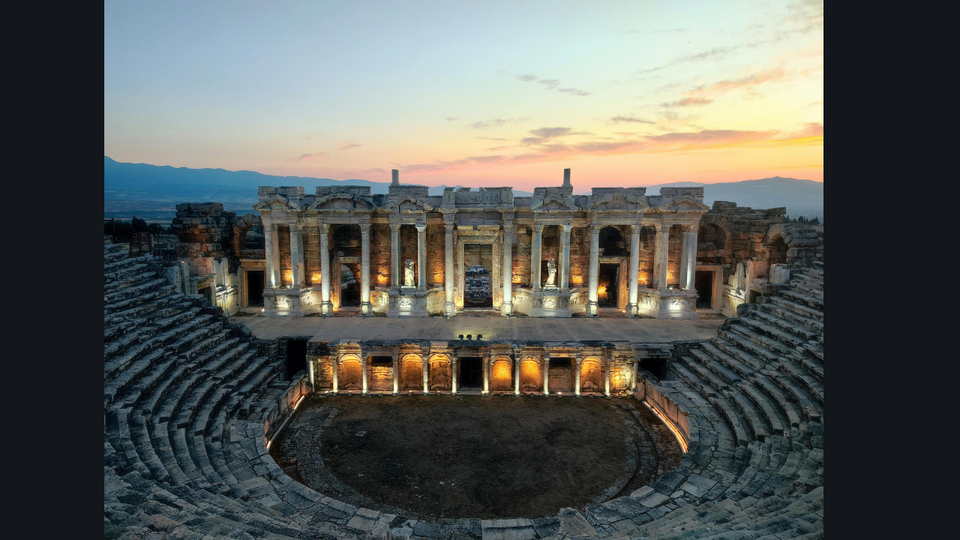
Ancient Greek theater was built in open-air amphitheaters, with audiences rising in tiers around a central playing space.
Two thousand years later, Boston directors are still thinking about how the shape of a room changes the way a story lands. In this week’s episode, both Courtney O’Connor (Penelope at Lyric Stage) and Christine Hamel (Medea at BU) talked about how stage configuration — thrust, proscenium, black box — shapes the audience’s role.
If you don’t spend your days thinking about theater architecture (no judgment if you do!), here’s a quick guide to the spaces we’re talking about.
Proscenium
This is the classic “picture frame” stage. The audience sits on one side, facing forward, watching the world unfold through a framed opening. It’s the layout many of us imagine when we think of traditional theater — curtain, arch, lights dimming.
At Boston University this season, The Oresteia will be staged in a proscenium theater, a format that emphasizes scale and spectacle. You observe the story from a defined vantage point.
Other examples are the Citizens Bank Opera House, the Huntington Theatre, and the Cutler Majestic Theatre.
These spaces often support larger-scale productions, big musicals, and visually expansive staging.
Thrust
In a thrust configuration, the stage extends into the audience, with seating on three sides. The performers are surrounded. The distance between actor and audience shrinks.
Lyric Stage is set up in a thrust format. Many other theaters in Boston can be set up in this format as well, including A.R.T.'s Loeb Drama Center.
Black Box
A black box theater is typically a simple, flexible space — often literally a large, dark room with movable seating. There’s no fixed stage. Directors can configure the room as proscenium, thrust, or something entirely different depending on the production.
Local examples include Central Square Theater, BCA Plaza Black Box Theater, and Boston University's Studio One, as well as many more.
Arena (In-the-Round)
In an arena — or in-the-round — configuration, the audience surrounds the stage on all four sides. There’s no “front" and every angle is visible. For audiences, this creates a feeling of total immersion. You’re not looking into the story — you’re wrapped around it.
How Directors Use Stage Shape to Tell a Story
The shape of a stage doesn't just dictate how actors move and audiences sit. It also changes– or has the potential to change– how actors and audiences experience a story.
Hamel, directing Medea at Boston University this spring, is configuring the school's large black box theater into a thrust staging. That's on purpose. Hamel wants audiences to feel involved, even implicated, in the story.
There is no hiding in the audience… I would love for the audience to feel like they are in the hot seat.
A thrust stage might put audiences in the hot seat, but it can also create other feelings, too. In Penelope at Lyric Stage, the three-quarter thrust didn’t feel confrontational — it felt intimate. As O’Connor described it, “you are on the porch with her.”
And so because of the stage, an epic story shrinks. The room tightens. The audience leans in together. And before a line is spoken, the room has already decided something about your role. Are you there to watch? Or are you there to sit inside the story?
Member discussion