Theater Without the Canon
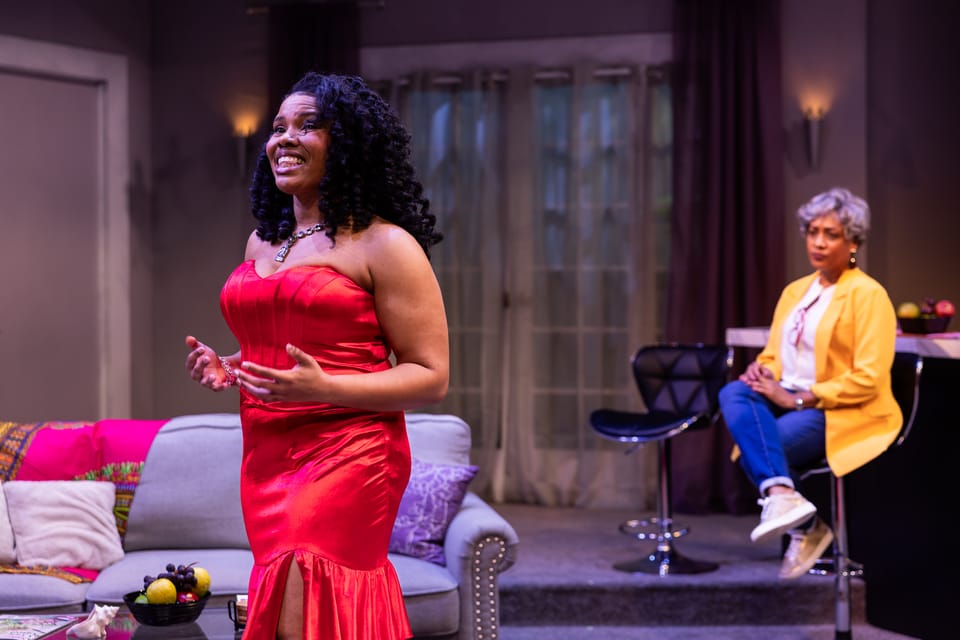
What Angry, Raucous, and Shamelessly Gorgeous reveals about experiencing plays for the first time.
Correction: The number of actors in Angry, Raucous, and Shamelessly Gorgeous has been corrected. It is four.
Last year, I saw Our Town for the first time.
Not “for the first time since high school.” Not “again, with fresh eyes.” For the first time. My only reference point was Ann Patchett's novel, Tom Lake, where the play hovers at the edges of the story as a character who doesn't give up any of their backstory.
And so, as Our Town ended and lights dimmed, I sat in my seat at the rear of the theater, tears streaming down my face.
Last night, I saw Angry, Raucous, and Shamelessly Gorgeous at Lyric Stage, and, unlike my experience with Our Town, I wasn’t starting from scratch. I was bringing something with me—some context, some language, some sense of how these stories move through the world. Which is, somewhat fittingly, exactly what the play is about.
This is a story about legacy—about who gets to carry it, and who gets shut out of it. Three Black actresses gather to honor a fourth, Anna, whose most famous role came from a radical staging of August Wilson’s work—performing his monologues in the nude, and taking on the roles traditionally written for men, as a way of claiming space for women’s voices in the canon.
Looming over everything is Wilson himself—not physically present, exactly, but conjured through light, sound, memory. His name is the gravity holding the room together.
And then there’s Pete, who isn’t orbiting him at all.
Pete is young and talented, but her experience is in porn and stripping... not theater. She's cast to take on Anna’s role, but—crucially—she doesn’t know Wilson’s work beyond the film Fences with Viola Davis.
The other women treat that gap like a moral failure. A disqualifier. Proof that she doesn’t belong.
And I felt that, deeply. Because I’ve been Pete.
There’s a particular vulnerability in coming to theater—or any art form—without the references. Without the shared language. You don’t get the inside jokes. You can feel the room responding to something you can’t quite access. It can make you feel like you’re already behind.
But being new isn't the same as being behind, as Pete shows us. And in the end, what’s so satisfying—what saves her from being a caricature—is that she makes something honest and instinctive. She responds as an artist, not as a scholar. And it changes how the others see her.
(It’s a little tidy as a resolution, but emotionally, it lands.)
Because the play isn’t really arguing that knowledge doesn’t matter. It’s asking who gets to decide what counts as knowledge in the first place.
Consider Medea, which also runs through Angry, Raucous, and Shamelessly Gorgeous. Not long ago, I might have skimmed past that reference. But after seeing The Odyssey and Penelope, both within the last year, I started noticing how many Boston theaters are staging Greek work right now, including Medea at Boston University (April 4–9).
After last night, when I see Medea, I'll also be thinking about what it meant for Anna to refuse the role of the nurse in Angry, Raucous, and Shamelessly Gorgeous. Similarly, when Actor's Shakespeare Project stages Wilson's Gem of the Ocean (April 16-May 17), I’ll carry Anna, Kate, and Betty with me.
You could make the case that this is how theater is meant to work—that it deepens with knowledge, with context, with time. But Pete points in another direction: That belonging might begin the moment you sit down, even if you don’t recognize everything in front of you.
And as I've learned over the past year, there’s a particular joy in encountering something without context, in letting it rearrange you before you even know what you’re looking at—a joy that leaves you in a dark theater, awed and a little undone, ready for whatever comes next.
🎭 On Stage 🎭
- Angry, Raucous, and Shamelessly Gorgeous
Lyric Stage Company of Boston
March 25- April 12 - Medea
Boston University School of Theatre
April 4–9 - Gem of the Ocean
Actors' Shakespeare Project at Hibernian Hall, Roxbury
April 16–May 17
Member discussion