Strings, Story, and the Stage: The Music of To Kill a Mockingbird
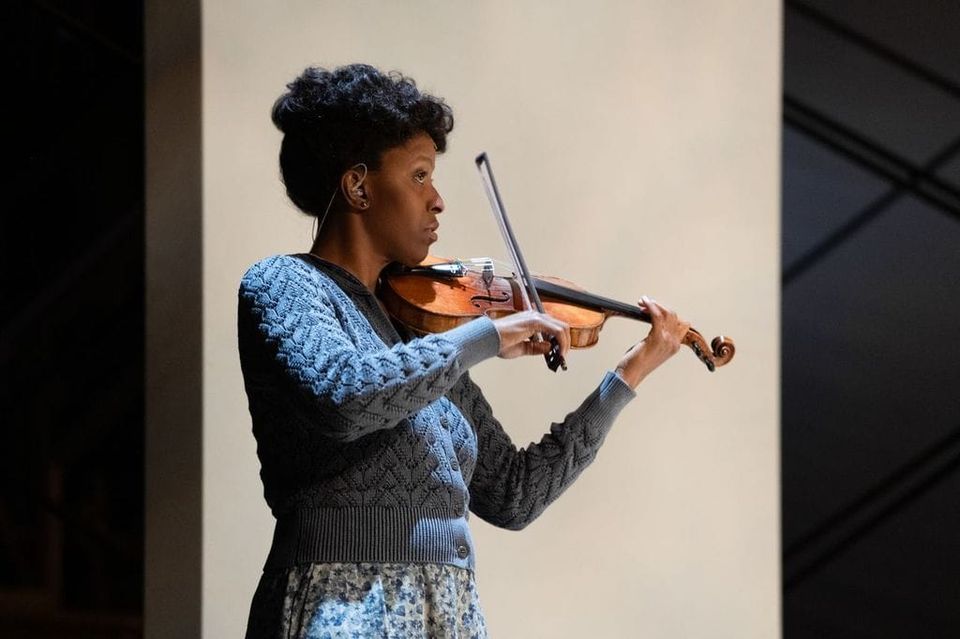
For a story abut injustice, I've always thought, To Kill a Mockingbird is deceptively cozy. There are children making adventures out of their neighborhood, a front porch, a father who seems to know how to make things right. We come to know this small town through the comforting rhythms of a family’s life—even as the story reveals how little safety that same town offers others.
The Huntington’s production of Aaron Sorkin’s adaptation gave that feeling a physical presence: warm orange lighting, soft wood tones, and, most notably for me, the music of Ashley Frith. I felt enveloped and rocked by it. How could a story so painful feel so welcoming? And what was the music doing that made me want to settle in and listen?
On stage Frith is an unassuming but captivating presence, moving through the stage with viola, violin, banjo, and her own voice. Her appearances offer little discoveries: another place in the world of the play, another sound that brings a scene into focus.
While the music brought warmth to the production, Frith describes her purpose in terms of holding and lifting the text, supporting the actors’ storytelling, and making room for feelings the dialogue doesn’t always express.
“There’s a lot of grief in this play,” she says, “but not always text for grief.”
That idea helped me understand something I’d felt in the audience but couldn’t quite name; the music offered another way to hear what the story was carrying.
In this bonus episode of Scene in Boston, Frith talks about finding those sounds—and knowing when to leave space for silence.
To figure out where music could lift the storytelling, Frith brought her viola into rehearsals and tried sounds as the actors worked through their scenes. She, sound designer Daniel Baker, and director Loretta Greco listened for what each addition brought to the text. Sometimes, they decided the words carried more weight on their own: after experimenting with music in the courtroom scenes, they left those exchanges unaccompanied. (An insightful decision, as anyone who has spent time in a courtroom with a "husher" on might agree.)
Elsewhere, the music remains responsive. Because Frith is onstage, able to see and hear the actors, parts of her performance have what she calls a “stretchiness.” The music can breathe with the delivery of a line or the space an actor leaves around it.
That attentiveness extends beyond the stage. Frith’s work in contemplative care and anti-racism informs how she approaches the production, from supporting the people around her to sustaining her own ability to perform a painful story night after night.
The conversation opens a window onto the care behind the performance: the trust a company builds, the attention musicians and actors give one another, and the work of returning to it all the next day.
Harper Lee’s To Kill a Mockingbird, adapted by Aaron Sorkin and directed by Loretta Greco, runs at the Huntington Theatre through November 8. Tickets and production details are here.
Thanks for being part of the Scene.
Laura
Scene in Boston is independent arts journalism. If you value conversations like this one, please consider making a contribution at sceneinboston.org to help keep them going.
Member discussion